
ACT ABA Goal Bank | 60 Observable & Measurable Goals
$17.99
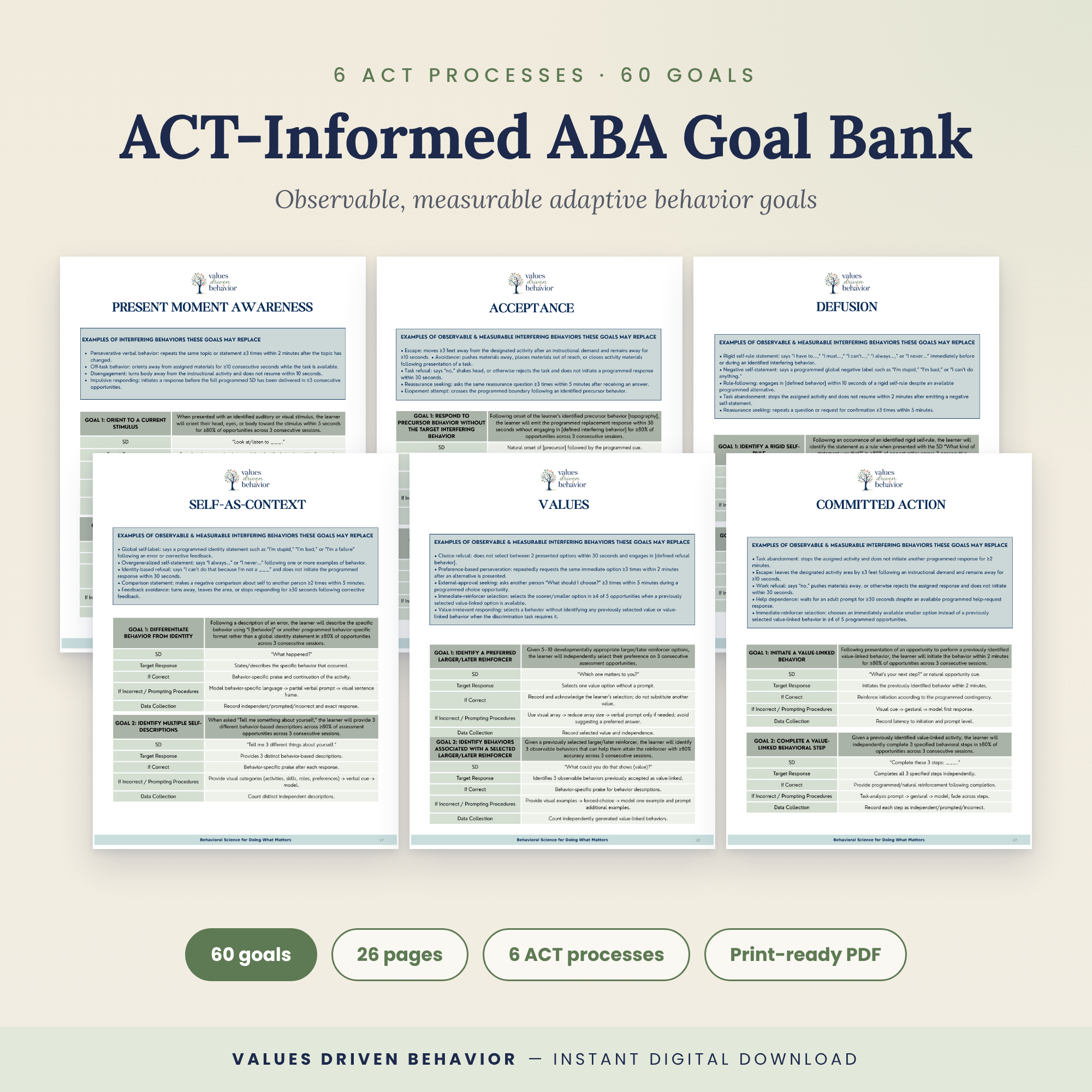
60 ACT-informed goals written the way ABA goals should be: observable, measurable and ready for your treatment plan. 10 goals for each of the six ACT processes.
Description
ACT-Informed Goals—Written Like ABA Goals Should Be.
Love the flexibility and values-based approach of Acceptance and Commitment Therapy, but struggle to translate ACT concepts into observable, measurable treatment goals?
This ACT-Informed ABA Adaptive Behavior Goal Bank was created specifically to bridge that gap.
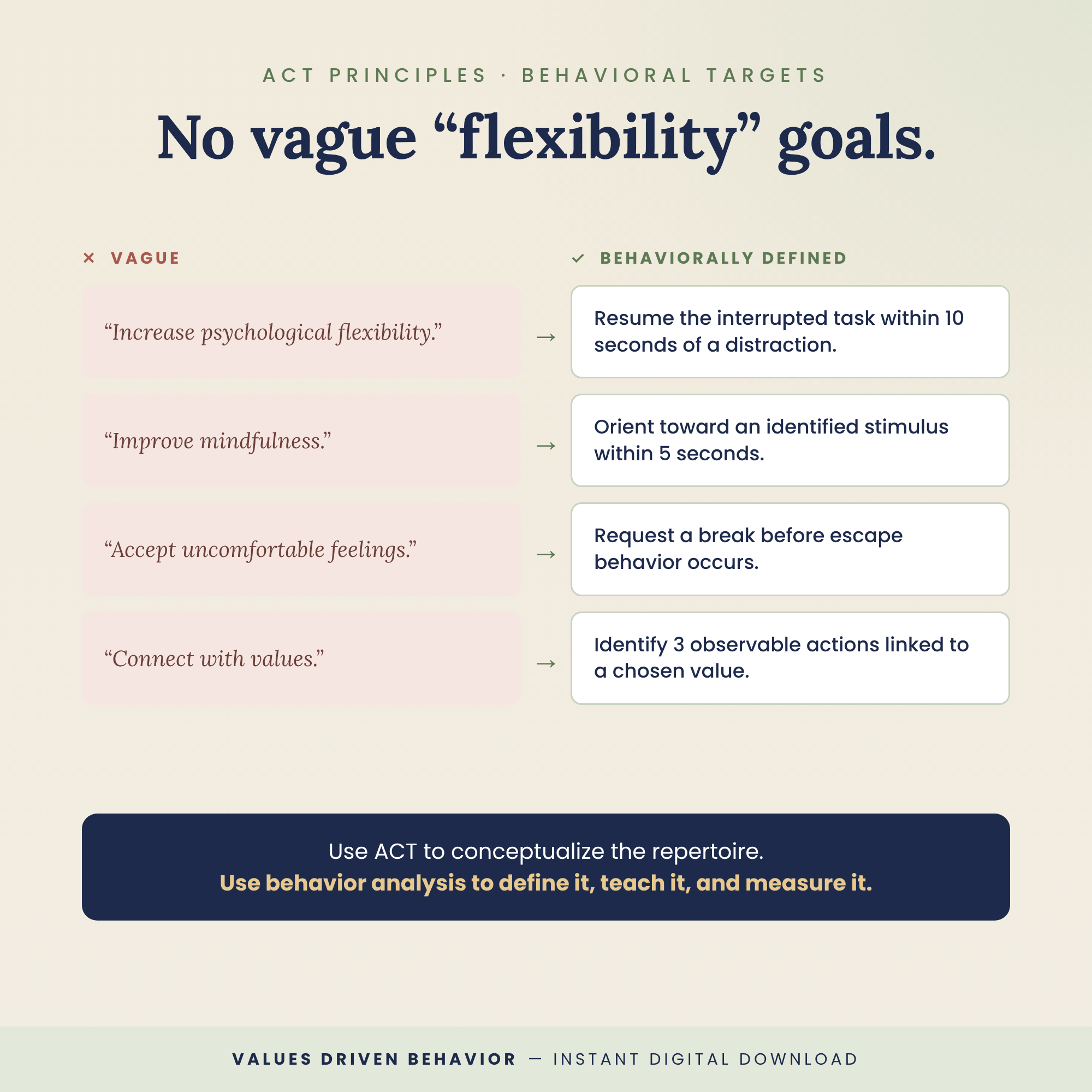
Instead of writing goals such as “increase mindfulness,” “accept uncomfortable feelings,” or “demonstrate psychological flexibility,” this resource translates ACT processes into behavioral repertoires that can actually be observed, counted, timed, or scored.
WHAT’S INCLUDED
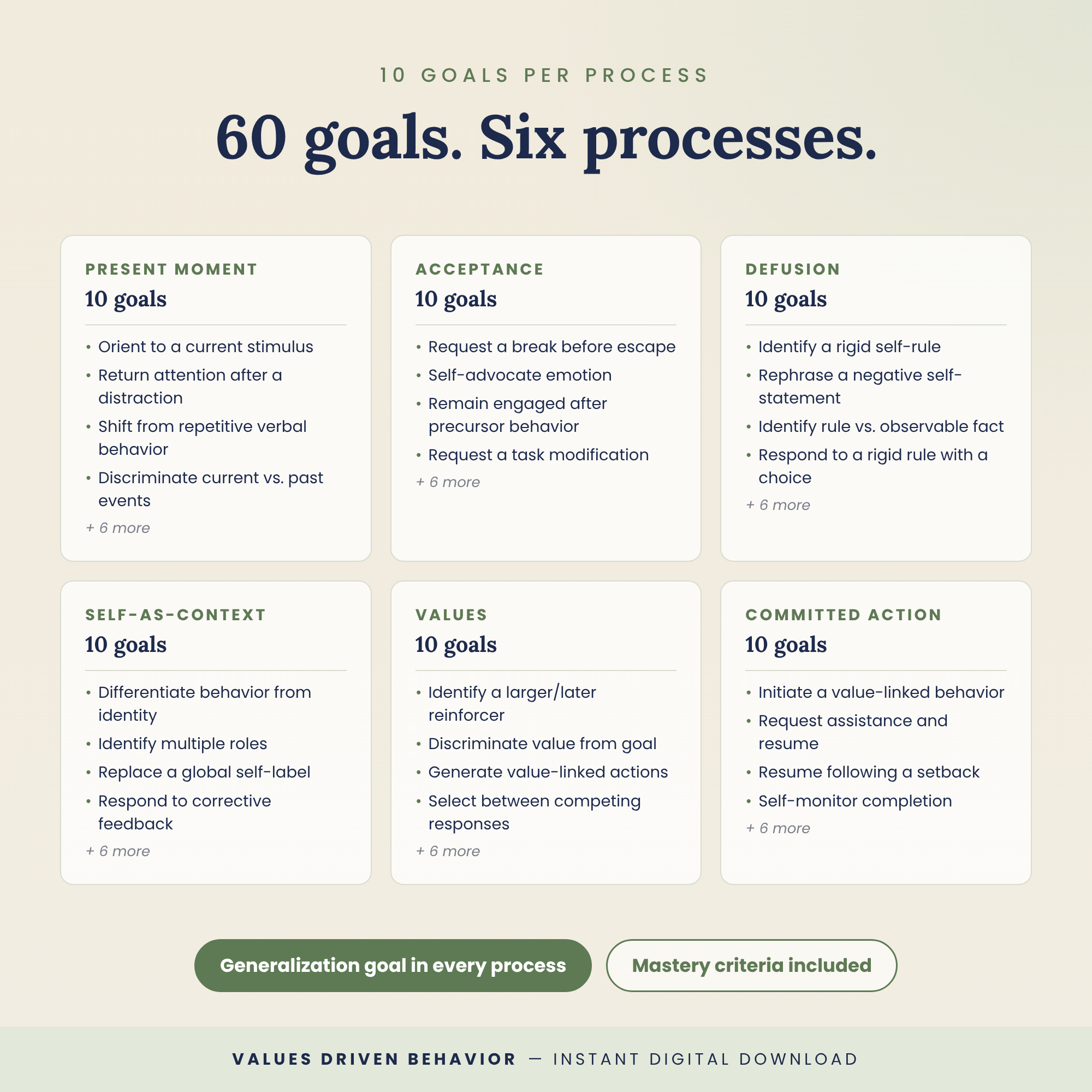
60 observable & measurable goals across the six ACT processes:
Present Moment Awareness
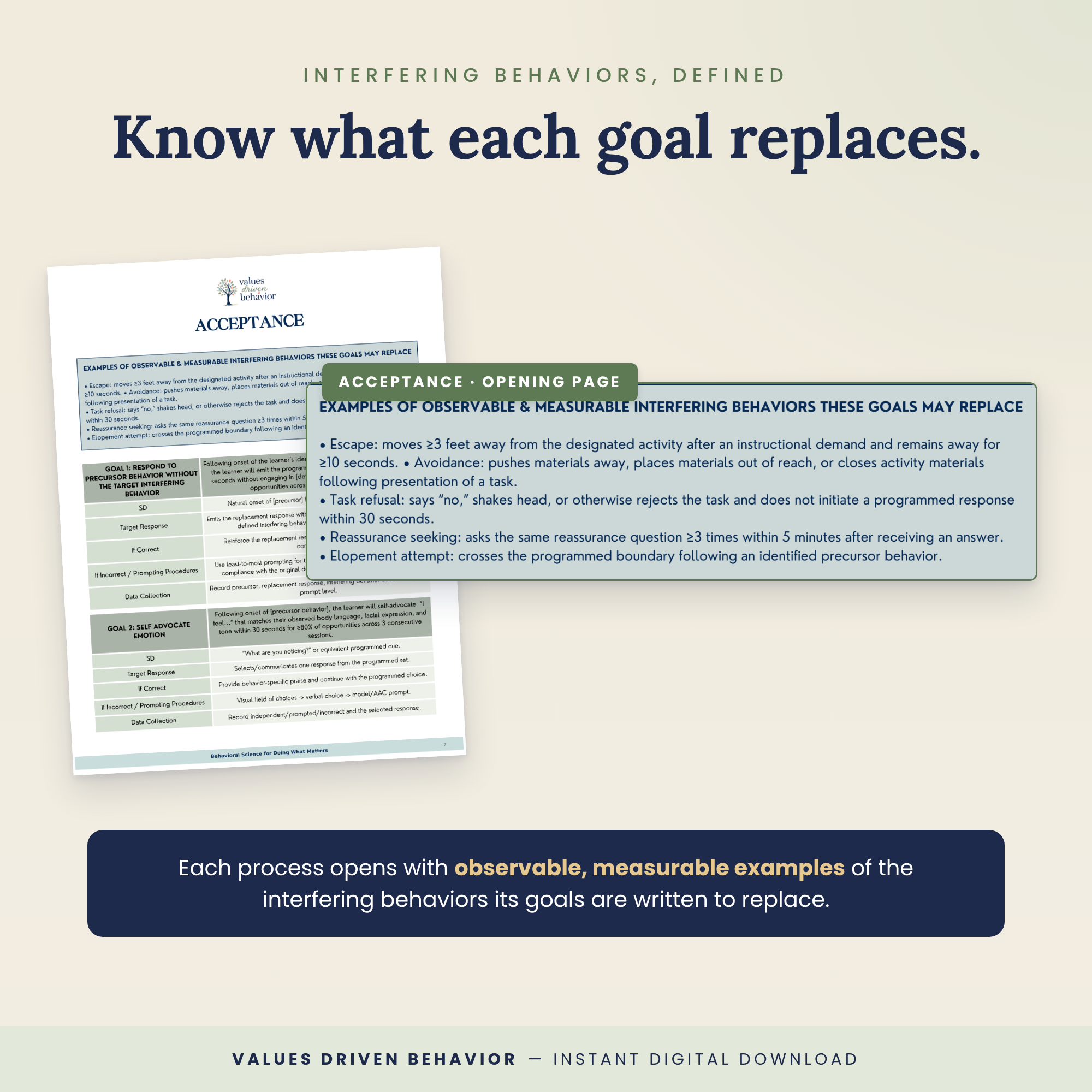
Acceptance
Defusion
Self-as-Context
Values
Committed Action
Each process includes 10 behaviorally written goals designed to help BCBAs move from an ACT concept to a clearly defined target repertoire.
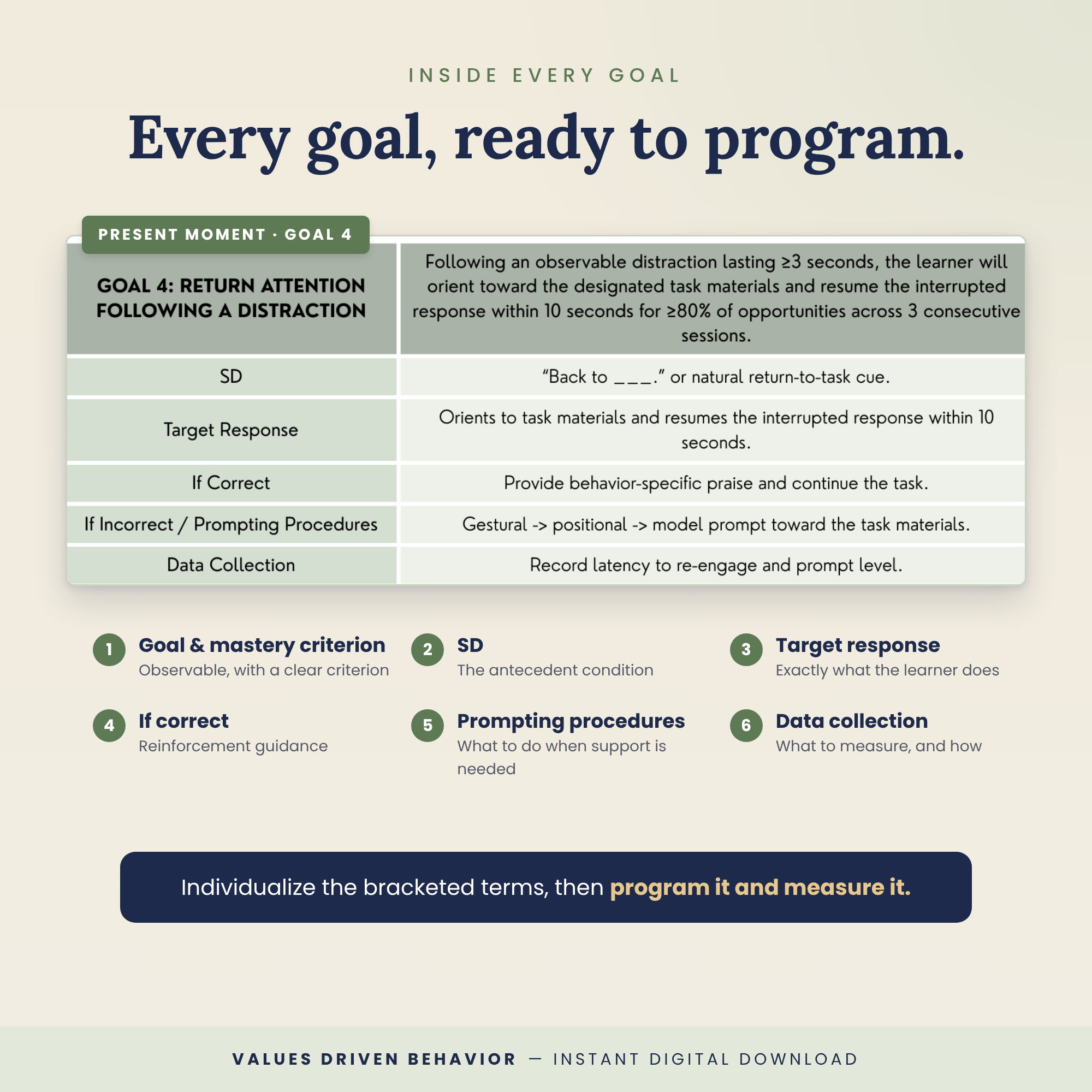
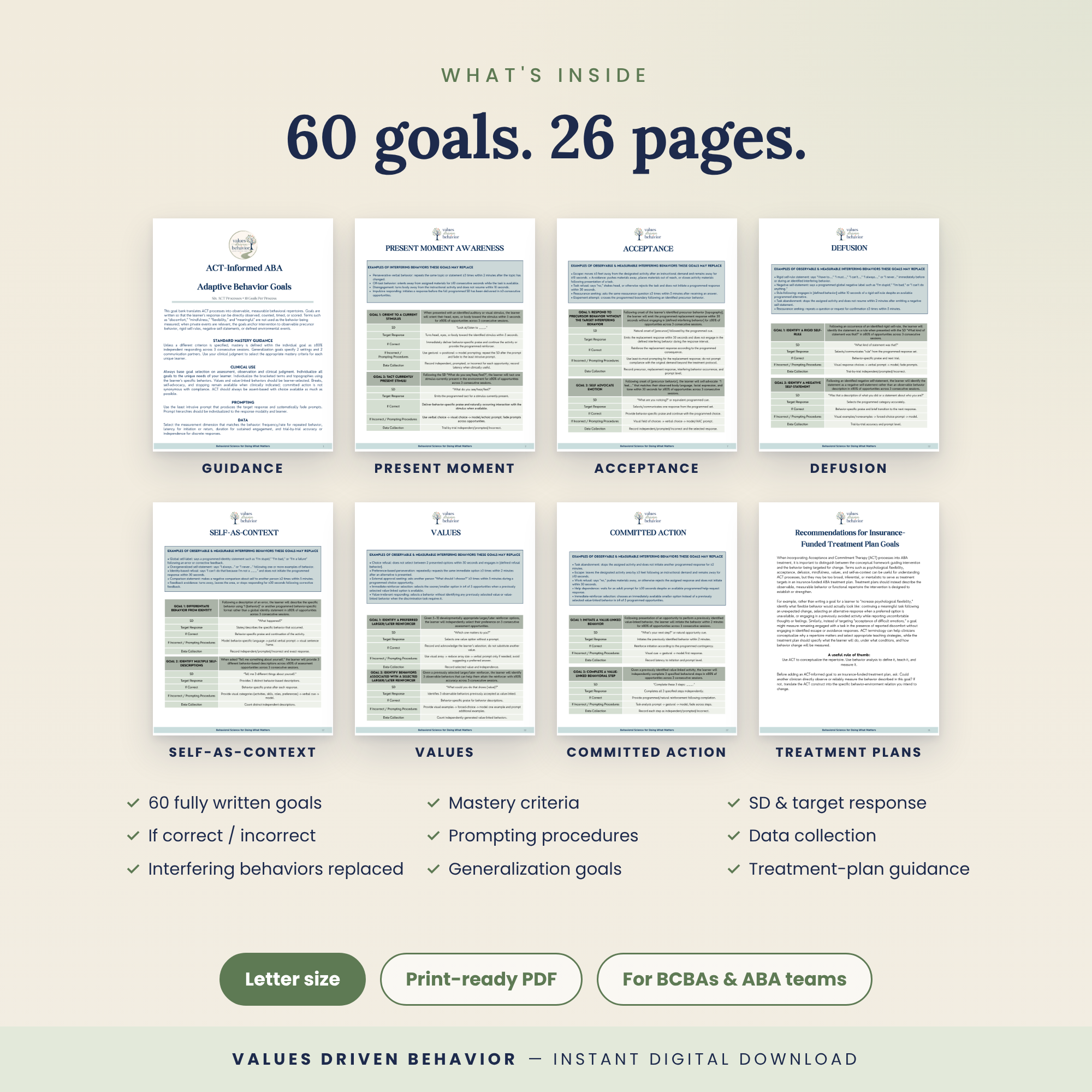
EACH GOAL INCLUDES
Every goal provides the pieces you need to move from treatment planning to implementation:
✓ Observable & measurable goal
✓ SD / antecedent condition
✓ Clearly defined target response
✓ Correct-response procedure
✓ Incorrect-response / prompting procedure
✓ Data collection recommendation
✓ Mastery criteria
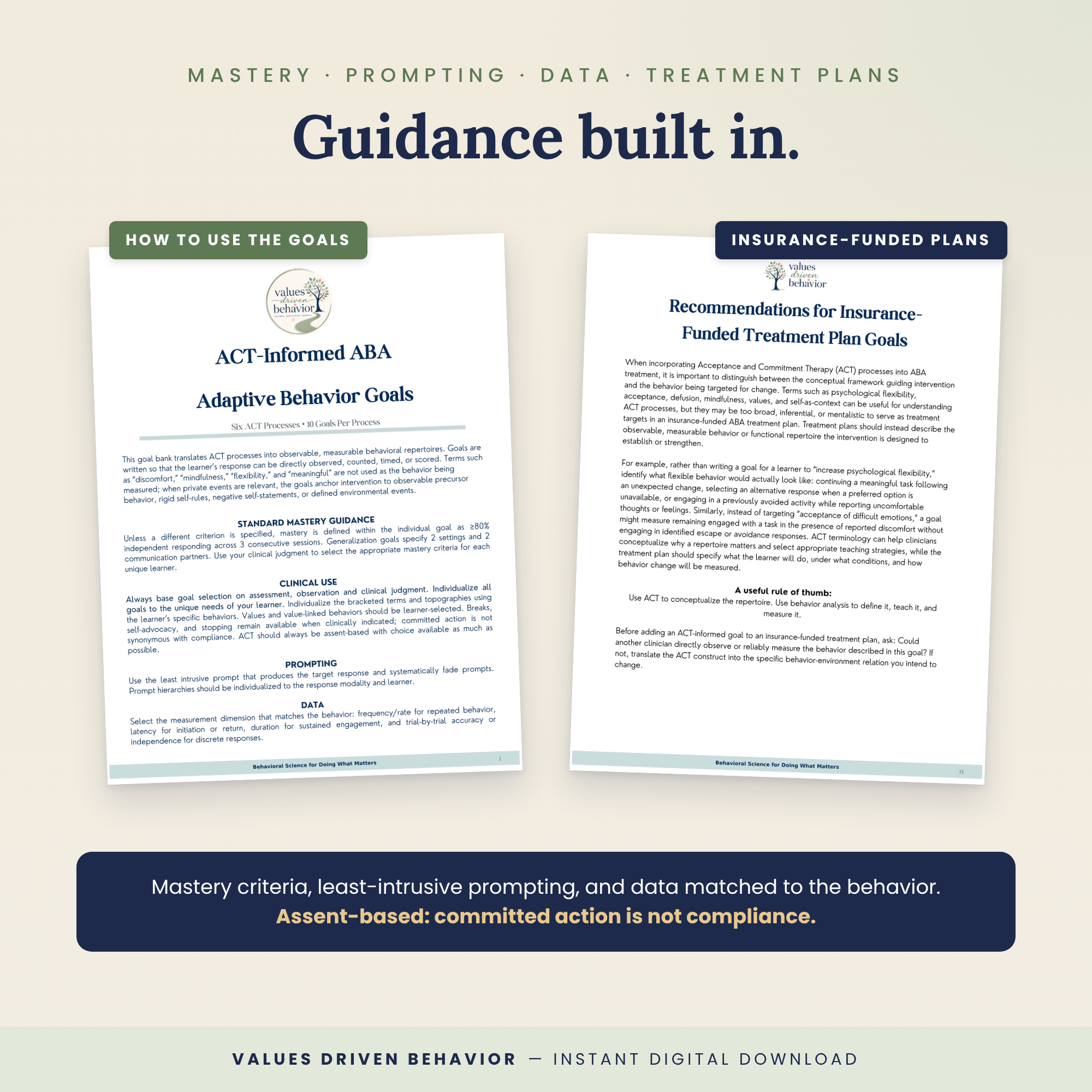
Measurement is matched to the behavior being targeted, including frequency/rate, latency, duration, trial-by-trial accuracy, and independence.
ACT-INFORMED. STILL BEHAVIORAL.
These goals don’t ask you to measure whether a learner “feels accepting,” “is mindful,” or “has become more flexible.”
Instead, you’ll find targets such as:
• returning to an activity following a distraction
• requesting a break before escape behavior
• selecting an alternative response
• responding differently to rigid self-rules
• generating observable value-linked actions
• initiating meaningful behavior
• requesting assistance and resuming an activity
• generalizing replacement responses across people and settings
For example, rather than targeting the private experience of “acceptance,” an Acceptance goal may measure whether a learner requests a break before escape behavior, with independence and occurrence of escape behavior collected as data.
DESIGNED FOR REAL-WORLD ABA PROGRAMMING
Use this resource to support:
• Treatment planning
• Goal development
• Program writing
• Clinical decision-making
• BCBA supervision
• Staff training
• ACT-informed ABA programming
Goals are designed to be individualized based on assessment, observation, clinical judgment, learner behavior, and context rather than copied into a treatment plan unchanged. The resource also emphasizes learner-selected values, self-advocacy, assent, and maintaining choice whenever possible.
WHY BCBAs WILL LOVE IT
ACT can be incredibly useful in behavior-analytic practice—but ACT terminology doesn’t always translate cleanly into an ABA treatment plan.
This goal bank does the translation work for you.
ACT concepts → observable repertoires → measurable goals → teachable responses → meaningful behavior change.
No vague “increase mindfulness” goals.
No measuring whether someone appears calm.
No mentalistic mastery criteria.
Just practical, individualized, behaviorally defined goals grounded in ACT principles and behavioral science.
Behavioral Science for Doing What Matters.
Digital download. No physical product will be shipped. This resource is intended as a clinical planning tool and does not replace individualized assessment, clinical judgment, or payer-specific documentation requirements.

Reviews
There are no reviews yet.